


What you will find in this section
The war is over. This revolutionary account of participant evolution means that science and religion need never again be enemies. The crucial shift in these pages is that we discover the human individual as a decisive agent in the evolutionary process, rather than as the passive vehicle for inhuman forces. We are introduced to the archetypes of the bio-social unconscious - the trinity of Ape, Angel and Outlaw - which guide us on our evolutionary path. (These also correspond to the primary layers - Earth, Heaven and Man - of human reality as depicted in the ancient Chinese philosophy - Yi Jing and Dao de Jing.) We also explore A.N.Whitehead's concept of early Christianity as a precious instrument of progress, the secret agent of cultural revolution. Whitehead claims the early Christian ethics provided a de-stabilising yeast for revolutionary aspiration, a perpetual re-infection by an uneasy spirit that made constant appeal to a higher justice.
You can respond
|
|
Who am I?
|
 |
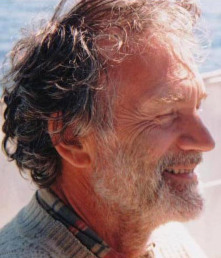
I am Michael Roth, the author of all
the material on this site. While training as a medical doctor, I was
also an alumnus at the famed AntiUniversity of London (1968-1969), and
became involved with the alternative psychiatry movement in that era
and later.
I worked and studied with the existential psycho-analyst
R.D.Laing, and was a founder-member of the Arbours Association
(London), which provides alternative care for persons diagnosed with
severe mental illness.
My research path has taken me into spheres of
philosophy, social politics, linguistics and anthropology - whilst I
have continued to seek out a genuine way of relating to other human
beings in the troubled milieux of psychiatry, communal living, and
twentieth and twenty-first century social and cultural instability.
I have been consistently inter-disciplinary in all of my
reading and exploration, and the personal and philosophical insights to
which this has given rise are almost always outside the prevailing
classifications - or accepted lists of subjects.
The following authors are they whose work I have been
most deeply occupied with, at different times in my life. This has
often entailed exploring what the actual world feels like, within the
patterns and definitions of life offered by these people. I have also
written extensively, and often critically, about many of them.
Philosophy
- Jean-Paul Sartre
- Martin Buber
- Lao Ze
- St Matthew
- St Mark
- St Luke
- St John
- Rudolf Bultmann
- Paul Ricoeur
- Richard Rorty
- Robert Pirsig
- Donald Davidson
- Jacques Derrida
- Benedetto Croce
- Charles Peirce
- John Dewey
- A.N.Whitehead
- J.H.Randall
- Justus Buchler
- Martha Nussbaum
Biology, Physiology, Ethology and
Cybernetics
Anthropology
- Mary Douglas
- Gregory Bateson
- Milton Ericson
- R.D.Laing
- David Cooper
- Clifford Geertz
- Victor Turner
Virtual Reality
Psychology
- Eugene Gendlin
- Arnold Mindell
- M. Scott Peck
I am the foremost exponent of Charlotte M. Bach's
ground-breaking theories of emergent evolution, described in my A Bolt From the Bleeding Sky
(Dielectric Publications, London, 1984). I continue to work as a
psychiatrist and as a researcher into holistic methods of facilitating
social change. This encludes facilitation and training sponsored by the
organization, Community
Building in Britain which continues to develop and disseminate the
work of the holistic psychiatrist M. Scott Peck.
I am also involved in an exploratory research group
seeking to fuse poetic, practical and fantastical modes of action to
create significant cultural/political interventions in the here and now.
|
|
Evolution in the Pattern of
Life.
I have already suggested that our search
for a better way to live is - in its essence - an evolutionary
search. It is the level of evolution which is most specifically our
own - and we should, perhaps, call this "the next level" -
because it is incomplete. This is evolution in the melting-pot, right
here and now, and it is for you and I to discover what the next steps
might be. To help us in our search, I want to introduce you to the Ape,
the Angel and the Outlaw - who are three archetypes, three main pivot
points, in a uniquely human domain of evolution
First, however, we had better consider whether this
is rightfully to be called "evolution"? How tight is the link, in other
words, with Charles Darwin's famous theory of "the evolution of
species"? To make sense of these questions, we need to bring some other
key concepts into play. Most especially we need to recognize the thing
that has been called "a pattern of life(1)
- which is an organised set of habitual readings and responses, in
relation to another organised set: of situations and goals
which pertain to the unfolding of our life as a whole. Going to the pub
on a Friday night - with the whole ambience and ritual that accompanies
the situation in the pub - is a pattern of life. The courting dance of
the three-spined stickleback is another one. It is in relation to these
relatively stable patterns of life, that we can define, and recognize
what an evolutionary path is. It is, quite simply, a
divergence from the pattern - such that a new version comes into
being, and an old version of the pattern is left behind.
Because of the obligations of life and community,
there is a tangible risk in living and moving within the relatively
uncharted space between the old and the new patterns. This risky place,
however, is precisely where we are: it is our concrete
experience of here and now - which I already characterised in a
different section, in the following terms:-
On the one hand, we inherit at each moment the
traces, patterns and pressures of the past - which throng about us,
hungrily seeking to embody themselves in this newly crystallising
moment. And on the other hand each moment is a re-birth, an opening on
to what is new. To this extent it carries for us the possibility of a
new direction, a new point of departure. We exist in the cross-current
of these twin forces: of repetition, and of renewal
I have also pointed out the resonance of my project
with the Dao-ist teaching. We should also recognize that this same
gesture of Pointing the Way is also to be found amongst the
later biblical Jewish prophets and in the original tenor of the
teachings of Jesus Christ, of the prophet Muhammed, and of the Buddha.
There is a distinct family resemblance amongst all of these, which is
not always acknowledged: they all have in common a powerful evocation
of a path to The Good, combined with a disturbing lack of specificity
about what, exactly, we are meant to do. From my own perspective in the
twenty-first century I can give some additional context: that this is,
in essence, an evolutionary claim. We have a direction we must
evolve in, but it cannot be specified in advance of our actual choices
in the living moment. In my view, those versions of Judaism,
Christianity and Islam which pretend that the path is already
specified, are a debasement of the deeper religious insight. These
debased versions are, clearly, anti-evolutionary, since they claim that
the pattern for right living has already been set, and any deviation
from what the religious authorities tell us, is simply wrong.
The evolutionary perspective that I am offering, is
one in which we have a sense of right and wrong - which is
derived from the pattern of life which has kept our forebears and
ourselves alive for countless millions of generations. We also
recognize, however, that the new situations we are constantly thrown
into, are demanding something different from us. The old
pattern will not serve us; we have to find new and truthful responses
which will serve our future needs, and not mindlessly attempt to
recreate the past. Within this perspective there is a demand that we do
the right thing: but it will require all of our imagination, all our
intelligence, and all the wisdom we can muster, to discover what that
"right thing" might actually be.
This brings us to the clear point of contrast
between my own evolutionary approach, and Darwin's theory of evolution
of species. It is the difference between an observer's theory
of evolution - as if seen "from the outside", and our own perspective from
the inside of the pattern of life. Darwin's theory has the seeming
advantage of being able to define the old patterns (but only from the
outside); it also claims to understand the process of mutation - the
changes alleged to be taking place within the genetic(2)
material, so as to set the new patterns in motion. This, however, says
nothing about ourselves, struggling to understand the
evolutionary path we are on.
For ourselves, we have a very limited awareness -
consisting of those few aspects of the path which happen to be making
themselves manifest within the orbit of our present experience. If we
are leaving an old pattern behind, it is not given us to know with any
clarity or detail, what that old pattern is. Nor do we know what it is,
that we are evolving towards. From the perspective of our own, lived
experience it appears that we have only vague conceptions of these
things; these vague conceptions, however, are exactly what we need to
take our bearings from.
It is in this key question of getting our bearings,
that the Apes, the Angels and the Outlaws of my main title, can be of
help to us. We need to be clear at the outset, however, that these are
not the same angels who appeared to the Virgin Mary or Jeanne d'Arc -
living entities who intervened in the historical process and told the
key players what to do. Nor am I talking about the same apes whom we
may encounter in the increasingly threatened forest environments of
Africa and the far East. These are not even the apes whom Charles
Darwin was ridiculed for claiming close kinship with.
Archetypes: the Evolutionary Players.
The Apes, the Angels and the Outlaws stand for
a new kind of concept, that refers to real aspects of ourselves as we
impact upon each other in the here and now. This concept of the
archetype entered into our modern consciousness through the
psychological theories of C.G.Jung. At the deepest level of Jung's map
of the human mind, he points to a domain called: "the collective
unconscious". Here is where the Archetypes dwell: the Wise Woman, the
Old Man, the Warrior, the Siren and so forth. For Jung, these are
inhabitants of a psychological landscape; they are inhabitants of what
he called The Psyche. We depart from Jung, however, in insisting that
these are active agents within our lived reality: these are who we
are - in the real, immediate interplay of one with another, as our
relationships unfold. We can think of them in another way, however: as
fundamental templates, which guide the pattern of our mutual impact, as
this unfolds itself in the here and now.
The Ape, the Angel and the Outlaw, then, are
archetypes - and this means that they are real players, on the stage of
Evolution. The Ape represents the pattern we are leaving behind. This
is not to say that we are descended from apes, but simply that
each of us carries this inner archetype of the pre-historic pre-human
being - who probably resembled our present-day apes more than any other
animal currently known to us. The Angels are likewise archetypes: but
they represent our future. They are the images we have created,
of The Good(3) which we are
attempting to evolve towards. The Outlaws, finally, are ourselves,
wanderers through the labyrinthine present times of the evolutionary
path. We are no longer bound by the law of the apes, but not have we
yet attained to the law of the angels. Each one of these archetypes,
with their very distinct relationship to the Law, is a different aspect
of our ourself, and known to us only indistinctly.
It is worth noting that the ancient Chinese
philosophy - which I understand as being an evolutionary perspective
with strong resemblances to my own, had a similar threefold division to
the one I am offering, but distinguished as three realms: Earth,
Heaven, and Man. I have a reason for preferring my own
terms - which is that they are more personalised - more readily
identified as aspects of our own selves. And since they all interact in
real time - both within ourselves, and between ourselves, it is not
helpful to picture them as inhabiting separate "realms". They are all
here, and now.
Meet the Ape.
Our "ape" essence is effectively a complete
behavioural programme that each of us has inherited from our
evolutionary forebears. This is, as I have said, the pattern that we
are evolving away from. This "moving away" has a paradoxical
aspect, however, since we must also continue to embrace our ape-hood (4) as our most comprehensive source of
orientation - within the system of life in which our personal existence
unfolds. Broadly speaking, whenever there is a wave of evolution that
carries us "beyond" our ape-hood, it needs to be complemented with a
wave of integration that will gather up all of our ape essence
and re-integrate it into the newly forming pattern. Without this we are
in danger of losing whole tranches of our ape-wisdom, or else of
rejecting the innovation (because it does not "feel right") before we
have explored it sufficiently to discover its full value.
Because our ape-like ancestor was a highly
socialised creature, he and she were always ready to adopt the cultural
mores, and happy to learn any desired cultural skills, which may have
been the order of the day. Thus it is not some remote ancestral ape,
whom we are leaving behind us - but that clever ape who was
impersonating us only last century, or a decade ago, or perhaps last
week. The time-scale that concerns us in the one which relates to the
particular struggles we happen to be engaged in today.
In any given moment of historical time, we can
think of ourselves as the ape who is desperately trying to be human,
but regularly failing; this creature is trying to meet the human ideals
which are held out before him, or her. The gap between the ideal and
the performance is always something of a puzzle. We do not know if it
is caused by a failure of apprehension, or whether it is a
failure of performance. Crucially, at the time of the mistake,
or failure, or sin, we are lacking a clear appreciation of what kind of
failure this is; it is for us to discover in the aftermath.
Sir Gawain and the Green Knight: (the trials
of the ape.. in the prison of his desires and ideals).
Let us consider the case of the hapless Sir
Gawain, immediately after his decisive battle with the evil and
horrible Green Knight. He discovers that - in his last adventure but
one - he has been the dupe of an enchantment. He had been tricked into
betraying his chivalric ideals, by the imaginary seductive wife of the
imaginary Lord who was the Green Knight in disguise. Gawain is plunged
into shame and despair. How is he to understand his failure to live up
to his ideals?
One possibility is that the very ideal he was
striving towards, is the thing that is at fault - if only because he
had elevated it to a status of melodramatic, perfectionistic
seriousness. (Such seriousness is certain to be punctured, once
supernatural tricksters get involved in the action, and this is exactly
what has happened in the adventure we are discussing.) On the other
hand, there may be some element within Gawain himself, which is not yet
ready to conform to the ideal - in other words, a failure of
performance. Even if the failure is his own "fault", it is not
necessarily ground for shame or this collapse into self-accusation. His
orgy of breast-beating may be more than a little beside the point.
There are two broad alternative interpretations of where Gavain is at,
either of which would be a better place to focus his energy. It may be
that he needs to steel himself for a redoubling of his moral efforts.
Or alternatively, he needs to seek a more relaxed and intelligent
approach to these bizarre challenges which his life is confronting him
with.
In any such case - and this applies equally to
ourselves as to Gawain - whatever it was that causes us to fail
is not something we can simply write off, or leave behind us. We need
to have some interest and curiosity, into the manner in which we
fail - for this is a clue to the integration of ape and angel.
Somewhere hidden behind this "failure" is the essential clue to our
higher-level task. For there is always this hidden level of reality:
the evolutionary task which is the true reason for the immediate
knightly quest. Thus we see that is no solution at all, for us to try
to repudiate the ape within us. Perhaps it is a flaw in our nature:
that we are so easily seduced by imaginary lovers. Yet to deny this
aspect of ourselves is also to deny the biological ground of our being.
Such an imposture must surely damage our health and fitness, but it
will also fatally interfere with our commitment to keep on the track of
our evolutionary task.
Meet the Angel.
The "angel" is the perfected human being we
are evolving towards. This exists in present time in the form of
images or archetypes of the qualities and traits we seek to embody.
These are, as I was suggesting in the discussion of Sir Gawain, targets
which we regularly fall short of. In the old cosmology, angels were
regarded as deathless and eternal in their unique essence. This
attitude, however, is part of the debased version of religion which I
mentioned earlier in this chapter - the interpretation that denies
evolution and pretends that the Good has already been fully specified.
Then the idea of "goodness" is reduced to the act of conforming to our
instructions, in every detail (5). This
betrays a deep misunderstanding of what it means to be a living species
in the midst of our own evolutionary process. Our ideals actually evolve
with us. The angel archetypes appear to be fixed points,
but only according to the short time-scales wherein we blunder about,
in our unique, personal, non-angelic fashion. The archetypes are fixed,
but only relatively - in comparison with our day-to-day scurrying
about. On a longer time-scale they must move.
As soon as we take the historical dimension into
account, we are able to recognize that a radical evolution has indeed
been taking place - for example - in the personality of the Gods. Once
they were entangled in unceasing egocentric and ruthless intrigue, like
the gods on Mount Olympus, outside ancient Athens. Or, like the early
"Lord of Hosts" of ancient Israel, it was a God who smote one's
enemies, mercilessly, but seemed to be strangely lacking in sympathy
for the wider sweep of creation. Yet even in ancient times Socrates,
Plato and their students were busy evolving their concept of the Highest
Good. This was later melded by the early Christian Fathers and
Mothers with the late Hebrew Jehovah: the loving, merciful, invisible,
inscrutable, father-and-mother of all creatures.
Our angels have been evolving within the modern
era, too. We now value honesty, authenticity and freedom(6)
in ways the ancient peoples had narrow or confused conception of. So we
have a newly enrolled trio, in our own choir of angels; they are still
finding their feet, perhaps, and have not yet succeeded in clarifying
their relationship with Piety, Valour, Humility, Civility and the other
old-fashioned virtues. We are in process of fashioning other angels
too, who have yet to gain proper ascendancy. For example, we are
reaching towards a sense of justice which is outraged by the rampant
exploitation and impoverishment of peoples all over the planet. This
sense of justice, we should note, is insincere until and unless it is
coupled with effective action. Thus we are called to generate some
genuine and widespread concern that such exploitation and
impoverishment shall come to an end. At the time of this writing, such
a concern has yet to be fully articulated and made practical(7).
There is also a sense abroad, that each and every
human being is precious and unique; this, perhaps, is equivalent to a
special guardian angel for every person. In that case we would have to
wonder why so many millions of human beings are allowed to starve each
day; it appears we are grievously lacking in commitment to each
other's guardian angels. So there are a lot of new angels on the
scene; and our present-day global confusion must forcibly remind us
that the angel archetypes are ideal - as yet, they have not
confidently taken up residence within our day-to-day practices.
Having no other guide to what is good, each of us
continues to take our guidance from our own, somewhat arbitrary,
selection of angels. In other words, we follow whichever ideals we have
learned to pay attention to. And as of the time of writing, I find
myself forced to accept that conflict, confusion(8)
and injustice are tending to prevail. Our multiplicity of angels
clearly have a task on hand, to discover how to live in harmony with
one another.
Meet the Outlaw.
My choice of the character of "the Outlaw" to
symbolise the questing, experimental aspect of our life in the present
moment, is in recognition that the Ape and the Angel are, in effect,
governed entirely by the law of their own nature. The ape is compelled
by her instincts, customs and habits; the Angel is compelled by the
ideal which she embodies. We, however, have the capacity to envisage
alternatives, to explore the implications of different paths, and to
make choices between them. This entails the suspension of the laws that
would otherwise bind us. So it is, that The Outlaw is an
essential pivot-point in our map of who we are. The Outlaw is the
aspect of ourselves who does not fit the prevailing norms and
definitions, within the culture and sub-culture we are expected to live
in.
The romantic version of "The Outlaw": from Robin
Hood to Dick Turpin, Western Movies and Easy Rider - represents
just one aspect of the outlaw archetype. Here is someone who overtly,
and rebelliously, breaks the local laws, and gets to be hunted down -
by the legitimate authorities or (in the case of "Easy Rider" by
conservative rednecks). Outside the romantic narrative, we have to
recognize as a fact of our lives, that the prevailing norms and
expectations within the world we have been born into, are in some
important way irrelevant to the real needs which are alive and
essential in every actual situation. We may not consciously
understand what is wrong with the prevailing pattern, but we feel it in
our bones that something else is calling us - to a different
fulfillment from the ones our family or peer-group may have lined up
for us.
Within our map of human reality, the outlaw in our
sense is the primary labourer in the wild landscape of human evolution.
We, as the outlaw, are grappling with, and resolving, conflicts and
incoherencies within the prevailing cultural landscape - conflicts and
incoherencies which are largely unrecognized by the rank and file of
us, and may be only dimly understood by the outlaw themself. This is
the hard labour of carving out new pathways of sensibility and action -
pathways which others will follow in later times, when the risks have
become less and the social concensus has already begun to move in the
same broad direction. It is also the task of mediating between
the well-meaning ape, who is always ready to learn new patterns from
whoever is willing to demonstrate them - and the angel who embodies the
ideals which the present-day, obsolete society struggles to impose as
the norm.
The Jews of Galilee - the Oppressed and Outlaw
Tribe
Another aspect of the Outlaw archetype is the
sociological fact that it is the exploited, the excluded and the
downtrodden who have the most accurate knowledge of the nature of the
society which oppresses and excludes. The upper classes are cocooned,
relatively speaking, from the realities of the day - by their
privileges and by the work they do not have to do (since
somebody else is doing it for them). Or there is a different kind of
Outsider, who has excluded themselves by one means or another from
spiritual bondage to "the system", and whose mind is free to understand
the broader patterns of human struggle which characterise the present
day. This was the position of the Galilean peasantry, two thousand
years ago, whose cultural life formed the seed-bed for emerging
Christianity.
We easily forget that Christianity - right up to
the year 313 when the Emperor Constantine ordained it an officially
accepted religion of the Roman Empire - was the quintessential Outlaw
religion. The early Christianity, as A.N.Whitehead has so eloquently
accounted it, also inherited the deep spiritual insight of that
Galilean peasantry, who themselves were the Outsiders of the Roman
Empire. These inheritors of Abraham's ancient covenant with Jehovah,
had a thorough-going disdain for the laws and customs of Rome; their
primary allegiance was to their invisible, inscrutable, unnameable God.
And so it is that the early Christianity, with its commitment to the
highest Good and its repudiation of the prevailing Law, can give us
essential insights into the role of the outlaw within the adventure of
human evolution. Here is some of Whitehead's account of the
spiritual/cultural seed-bed from which Jesus of Nazareth emerged:-
"Having regard to their climate and simplicity
of life, they were neither rich nor poor: they were unusually
intellectual for a peasantry, by reason of their habits of study of
historical and religious records: they were protected from disturbance,
from within or from without, by the guardian structure of the Roman
Empire. They had no responsibility for the maintenance of this complex
system. Their own society was of the simplest; and they were ignorant
of the conditions by which the Empire arose, of the conditions
requisite for its efficiency, and of the conditions necessary for its
preservation. They were ignorant even of the services which the Empire
was rendering them."
"...The tone of life of this peasantry provided
an ideal environment in which the concepts of the ideal relations
between rational(9) beings could be
formulated - concepts devoid of ferocity, concepts gracious, kindly,
and shrewd, concepts in which mercy prevailed over judicial
classification. In this ideal world forgiveness could be stretched to
seventy times seven, whereas in the real world of the Herods and the
Roman Empire a sevenfold forgiveness touched upon the impracticable."
This, then, gives rise to the paradox that these
ethical principles - widely regarded as one of the towering spiritual
achievements of mankind - are incapable of promoting the viability of
those who espouse them. If we had put them into practice in most of the
real-life contexts we might have found ourselves in - wherever we might
have lived, and at any time over the past two thousand years - they
would be much more likely to hasten our own demise. Then we have to ask
ourselves: what is the real importance of these principles? Whitehead's
answer is that they provide an ideal standard by which we can evaluate
our progress, as an individual, as a society and as a civilisation.
"...The progress of humanity can be defined as
the process of transforming society so as to make the original
Christian ideals increasingly practicable for its individual members.
As society is now constituted (Whitehead was writing in 1932) a literal
adherence to the moral precepts scattered throughout the Gospels would
mean sudden death."
Another way to think about this is that the
Christian concepts - thousands of years ahead of their time - act as a
revolutionary or de-stabilising yeast, working away in the deep and
hidden places in every society they touch, and ready to help guide each
newly emergent impulse towards a better world. Whitehead again:-
"A gracious, simple mode of life, combined with
a fortunate ignorance, endowed mankind with its most precious
instrument of progress - the impracticable ethics of Christianity. A
standard had now been created, expressed in concrete illustrations
fool-proof against perversions(10).
This standard is a gauge by which to test the defects of human society.
So long as the Galilean images are but the dreams of an unrealized
world, so long they must spread the infection of an uneasy spirit."
As we shall shortly discover, the uneasy spirit is
able to express itself most powerfully through our poetic, intuitive
and emotional sensibilities. We shall also discover that this is the
key to unravelling whichever of the systems levels are of most
immediate concern to us. For the lazy-minded person, and those who have
strong vested interests in living a lie, however, the contradictions
are easy to conceal within the subtle structure of our lived reality;
the uneasy spirit is easy to suppress, or to cut and paste to some
location out of sight. Thus we need not be surprised that the European
capitalist and imperialist expansion was spearheaded by a debased form
of Christianity, and with surprisingly little bad conscience to show
for it.
Christianity, however, remains an Outlaw Religion
in its origins and its essential nature. In this capacity it offers
this continuing challenge: how I can live as one who - though perhaps
dwelling within the prevailing system of law, is not
essentially of this system. Those of us who wish to spearhead
the movement from the old system of values to the new (and as yet
unknown) system have to some extent to live outside the law. At least,
our higher concept of Good commands us: not to take the law
seriously.
This is not a call to abandon our ethical
commitments, but to recognize the call, that we seek to evolve a higher
ethical pattern of life. It is likely that this higher pattern will be
strongly informed by the teachings of Jesus the Nazarene, Mohammed, the
Biblical prophets, and Gautama Buddha. The search for this pattern,
however, is certain to call deeply into question the received ideas,
and the received values of the old civilisation. In a time of crisis of
civilisations - and this is what we are now living in - the Outlaw
spirit is the only one that can mediate effectively between the Ape and
the Angel levels of our existence.
And though the foregoing arguments will often seem
less than sympathetic to the fundamentalist(11)
versions of the world religions we have touched upon, we have to
recognize all of our fellow humans as companions in the travail. We are
all apes, all angels, and all outlaws to some tangible extent, and our
task is to find the way to share the earth in a spirit of co-operation
with each other, and with all our fellow creatures.
NOTES TO THIS SECTION
1. It was Ludwig Wittgenstein who
first elaborated this concept as an essential piece of equipment for
the orienteer on the human scene. With respect to Ludwig, I have found
it necessary to redefine this concept in my own terms and within the
evolutionary context which is being presented here.
2. It is likely that the insistence of
mutation at the genetic level, as the prime initiator of change, will
in the future be recognized as a premature assumption. Peter Cornell's
work - well summarised in his book Holistic Darwinism along
with a wide body of other relevant research - points to the
evolutionary unit being a wider system than that of the individual
organism. It also begins to appear that the rigid opposition between
"Larmarckian" and "Darwinian" evolutionary theory was an artefact
created by over-zealous neo-Darwinists. None of these arguments has a
very direct bearing on the question of "evolution from the inside" -
except that the neo-Darwinian zealots would probably like to take away
our right to be thinking in this fashion.
3. What about devils and evil spirits, I hear
you cry! Yes, there must be a reason why some people like to populate
their mythical world with demons (or just with one super-demon called
"Satan") as well as angels. Within my map a devil would simply be a
mistaken ideal whom we trick ourselves into taking for a valid ideal -
it would not deserve to be elevated into the same, or a rival, class as
the angels.
4. In speaking of
"ape-hood" I am not trying to say that humans are the direct
descendents of apes; my belief in the essential kinship of all living
creatures, however, forces me to the position that apes and humans must
have a common ancestor somewhere in our relatively recent
evolutionary past. This is the one we are evolving away from.
(The same principle implies that a common ancestor could be found for any
pair of living species found on this planet, subject only to our
ability to trace the lineage far enough backwards. So, for instance,
apes and lizards also have a common ancestor - somewhere in the
fishy, slimy regions of the more remote evolutionary past.)
5.
This appears to have been the position of "The Pharisees" depicted in
the New Testament, who were highly devout religious people with whom
Jesus was in constant contention. If this is correct, then the
Pharisees were not, essentially, bad people - but people trying too
hard, and in the wrong way, to be good.
6. A.N.Whitehead has written persuasively about the shift
in basic assumption between the ancient world, in which slavery
was an absolute given (and inseparable from civilisation as they then
knew it), and the era commencing with the French Revolution and the
Victorian Methodist reformers which has persuaded the world that
slavery is radically unacceptable. Clearly, a further evolution is
needed before slavery, and slave-like social conditions are completely
abolished. But the principle is now firmly established and an Angel of
Freedom is surely now in residence in the Kingdom of Heaven. Perhaps
she should always have been there, but we have no evidence that the
designers of the ancient Heaven gave her any serious consideration. See
Whitehead (@@@)
7. In my view, we can only address these
world-scale political and economic problems if we have an adequate
systems conception of how the problematic situation is created out
of real-time human activity. I see the present work as contributing
some of the essential thought structure, to enable these conceptions,
and the relevant systems mappings, to be developed. In the meantime our
"will" to make changes is inevitably weak, because it is not coupled
with an effective method.
8. Should Confusion
be regarded as the pseudonym of the archangel Satan? Or is it just
confusion? See footnote number three, above.
9.
Rational" in this context means being committed to the good of oneself
and of others, and searching for the bridges and the perspectives that
can lead to the action that may bring this good about. (Even Whitehead
was a little feeble on "the function of Reason" - but the whole topic
has been elegantly taken up by Justus Buchler (@@@)
10. One such perversion of Christian ideals is the
walking contradiction of the devout Christian who is also a ruthless
manipulator of capital. He does not recognize that he has any ethical
conflict - perhaps because these two sides of his personality belong to
different system layers of the human enterprise. On the one hand his
own economic activities do not bring him face-to-face with the
exploitation and human degradation which are the inevitable by-products
of the present global system. On the other, his Sunday Christianity
deals with an imaginary world, where idealised, imaginary "neighbours"
are "loved" in a stereotyped and idealised way. Thus he does not bring
the Christian ethics to bear upon the evils of the system in which he
is participating. Until he learns to think in terms of systems
levels his reasoning mind (which only addresses one layer at a
time) will fail to register any contradiction. See section entitled Layers of System for a
fuller discussion of this point.
11. I strongly repudiate the fundamentalist teachings
- but will continue to seek ways of maintaining dialogue with those who
espouse such teachings.
© all content: copyright reserved, Michael Roth,
March 2009 |
|